
 Romer Labs · Diagnostics
Allergen tests for food
Detect traces of allergens (gluten, soy, milk, egg) in food, rinse water and on surfaces — with on-site rapid strip tests or ELISA for quantitative analysis.
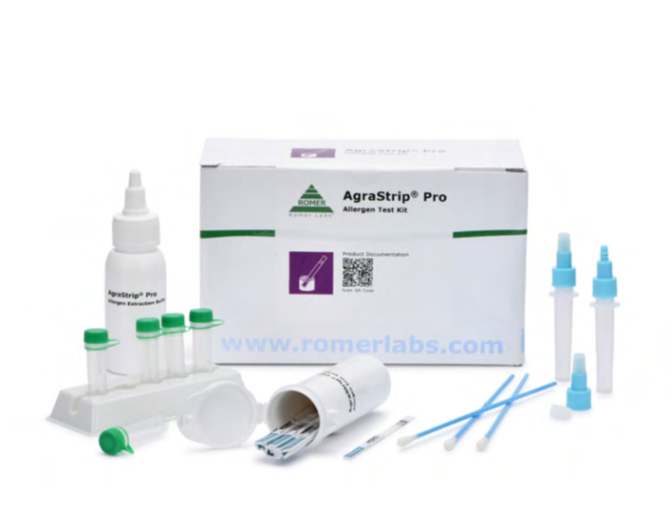
Rapid tests (strips)
On-site result in 11 minutes
- 11 minutes, including extraction
- On-site analysis, no equipment needed
- High sensitivity (low levels)
- Validated against PCR
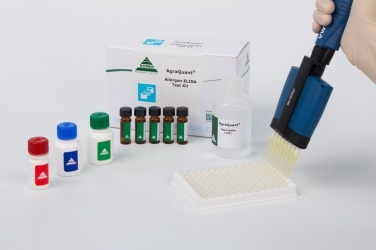
ELISA tests
Quantitative, many samples
- High sensitivity (low limits)
- Cost-effective for several samples at once
- Reliable ELISA method
- Gluten, soy, milk, egg and more
The 14 allergens you need to control
Regulation (EU) No 1169/2011 requires food manufacturers to declare on the label 14 substances that cause allergies or intolerances. A hidden allergen — one that enters the product through cross-contact rather than the recipe — is one of the most common causes of food recalls.
Romer Labs® tests cover most of them — from gluten, milk and egg to tree nuts, sesame and crustaceans.
Allergens in the HACCP plan
When products with and without a given allergen are made on the same line, the risk is cross-contact. Allergens are assessed as a hazard in the HACCP plan, and the Codex Alimentarius Code of Practice on Food Allergen Management (CXC 80-2020) recommends that control measures be validated and verified. Allergen testing is the objective proof that they work:
1Incoming raw materials
Checking raw materials that the supplier declares free of a given allergen.
Rapid strip test
2Surfaces after cleaning
Swab sample from equipment at product changeover — the key point for cleaning validation.
3Rinse water (CIP)
Sample from the final rinse water of closed systems — without dismantling the line.
Rapid strip test
4Finished product
Quantitative verification before labelling and release to market.
Romer Labs® allergen tests are suitable for HACCP, ISO 22000, BRCGS and IFS systems.
Rapid test or ELISA
| Rapid strip test (AgraStrip® Pro) | ELISA (AgraQuant®) | |
|---|---|---|
| Result | Qualitative (yes / no), in ~11 minutes | Quantitative, in ppm |
| Where | On site in the plant, no lab needed | In the lab with an ELISA reader |
| Samples | Single samples, at any time | Many samples at once |
| Sensitivity | from 0.5 to 10 ppm depending on the allergen | down to ppb level for some allergens |
| Typical use | Surfaces, rinse water, raw materials | Finished product, documentation, “gluten-free” |
Frequently asked questions
Which allergens must be declared on the label
Regulation (EU) No 1169/2011 (Annex II) lists 14 substances: cereals containing gluten, crustaceans, eggs, fish, peanuts, soybeans, milk, tree nuts, celery, mustard, sesame, sulphur dioxide and sulphites (above 10 mg/kg), lupin and molluscs. They must be declared in the ingredients list and emphasised.
Is allergen testing mandatory
The legislation does not prescribe a specific method, but it requires hazards — including allergens — to be managed according to HACCP principles. The BRCGS and IFS standards require validation and verification of cleaning with respect to allergens, and testing is the most direct way to prove it during an audit.
How to choose between a rapid test and ELISA
The rapid strip test is for daily on-site control — surfaces after cleaning, rinse water and raw materials, with a result in about 11 minutes. ELISA gives a quantitative value in ppm and is suited to finished-product verification and to documentation for customers and authorities.
Which allergens can be detected with Romer Labs® tests
Gluten, milk, casein, β-lactoglobulin, egg, soy, peanut, hazelnut, almond, walnut, cashew, pistachio, sesame, mustard, lupin, crustaceans and more. The full list with detection limits is on the strip test and ELISA pages.
Not sure which test you need?
Tell us which allergens and samples you test — we will recommend the right method and kits.